

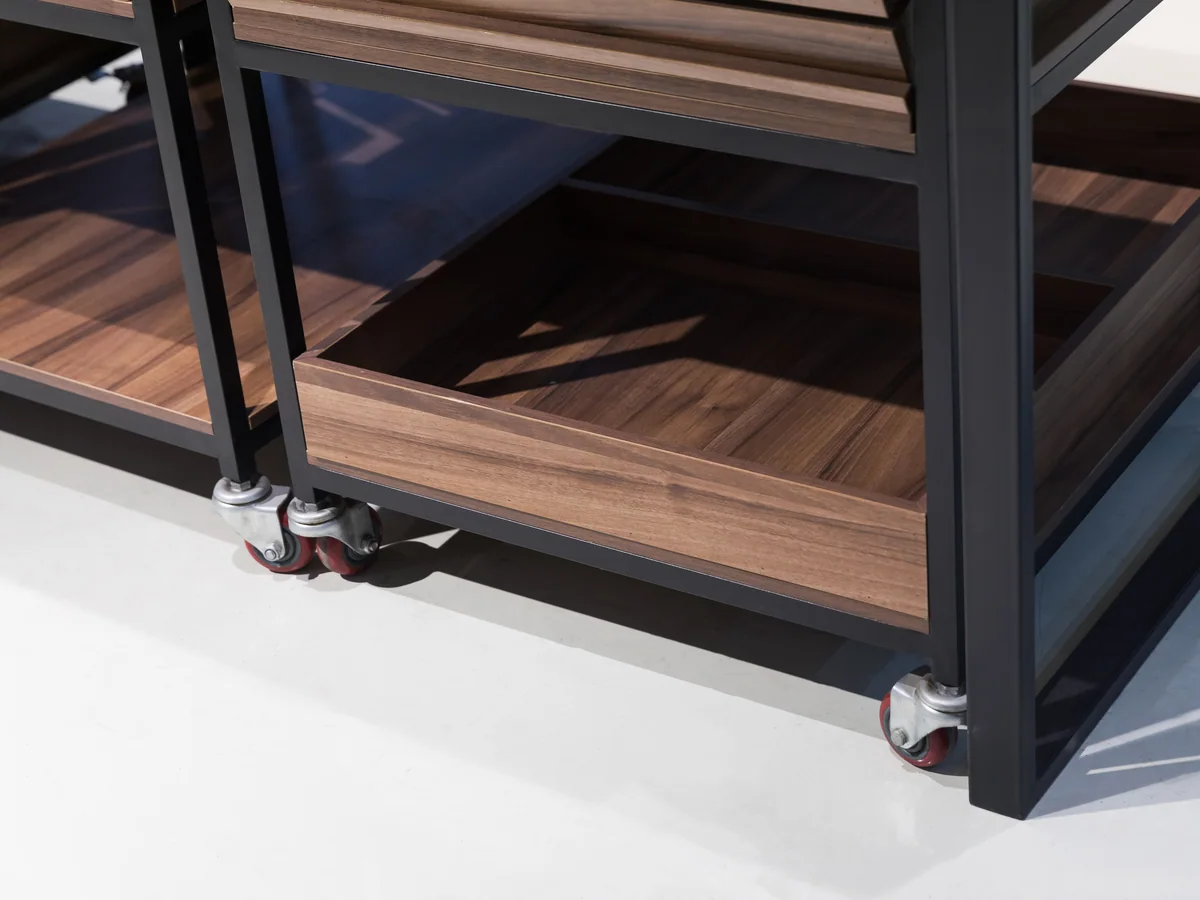
Castor
Braked or unbraked per order
The castor is what the whole build depends on. Braked or unbraked is set against your floor — on any slope at all an unbraked wine table is a fixture that migrates overnight.
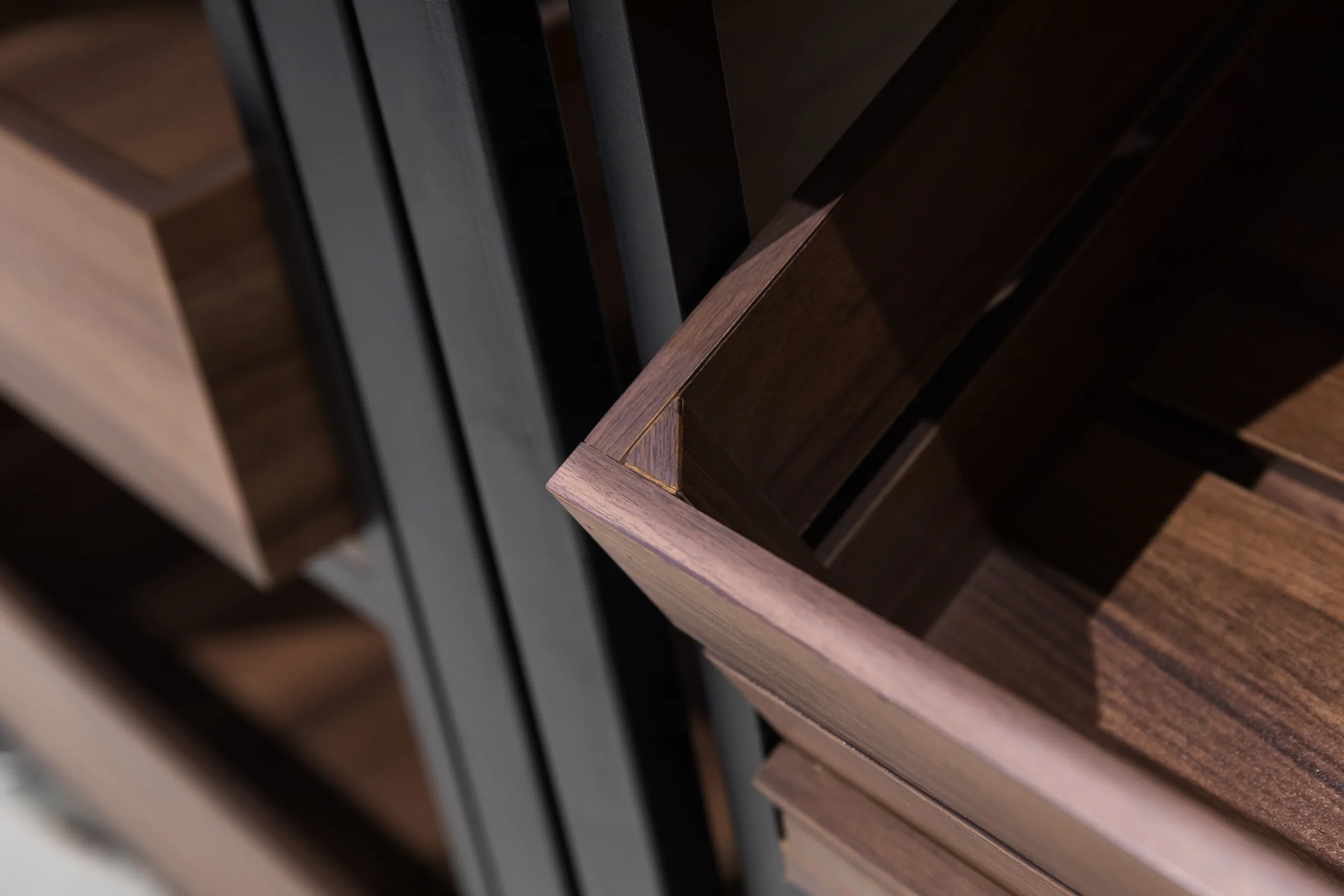
On castors · tiered table · crate storage
A tiered wine table on castors. Wine promotions move — to the entrance for a holiday, to the restaurant end for a food match — and a fixture that rolls is worth more than one that has to be carried.
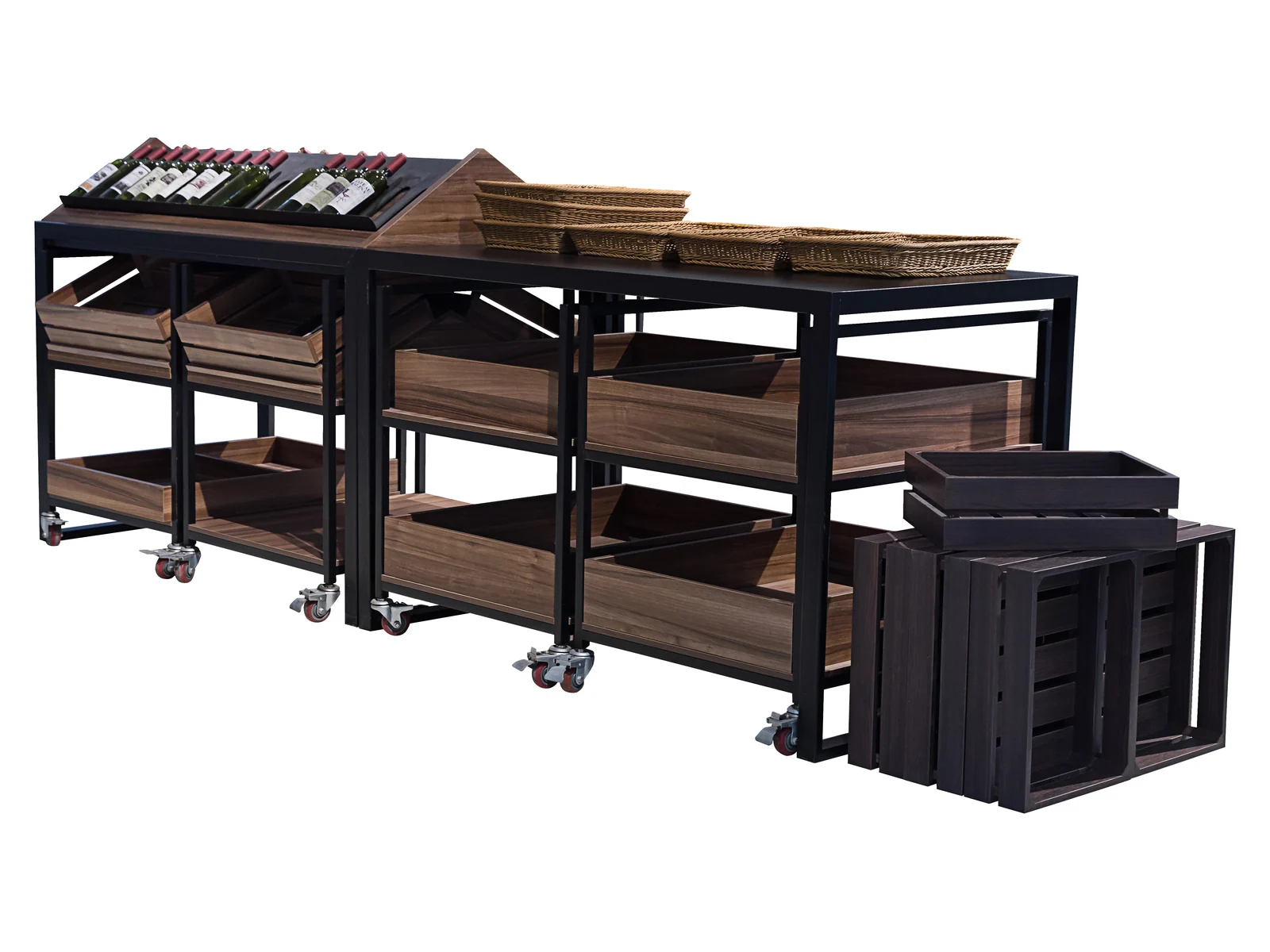
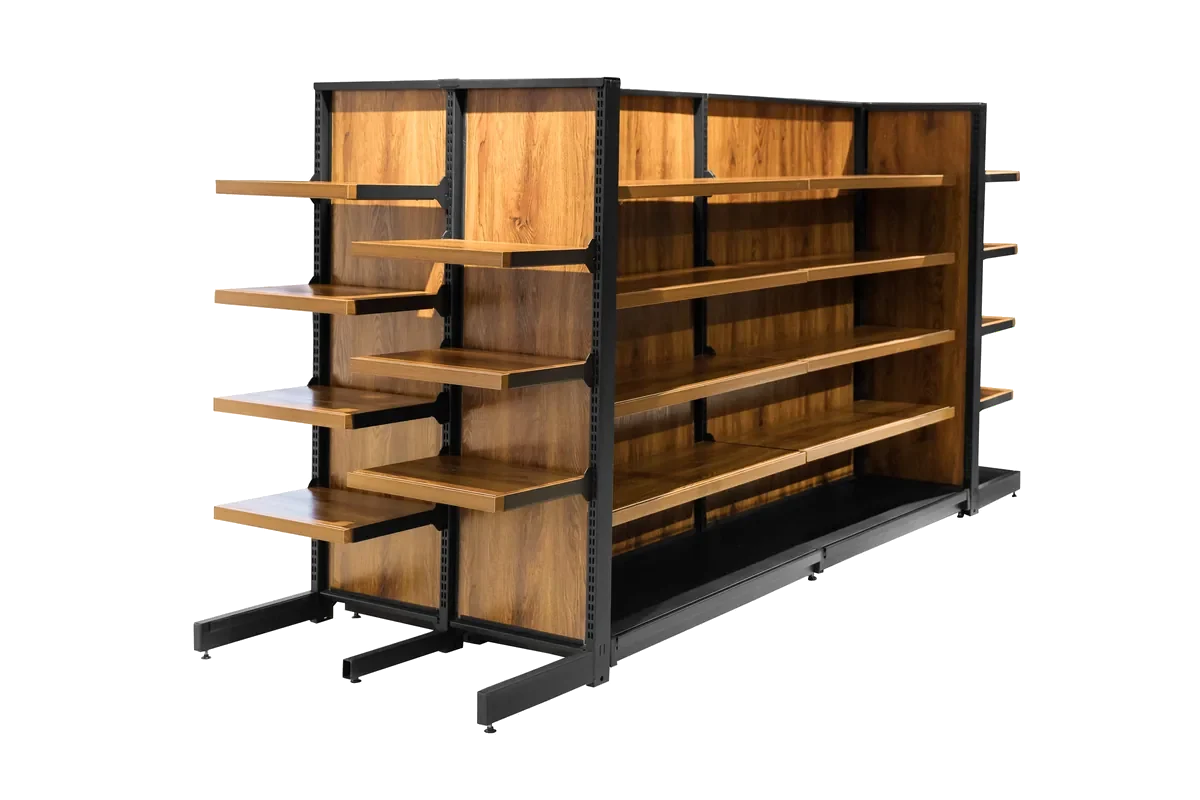
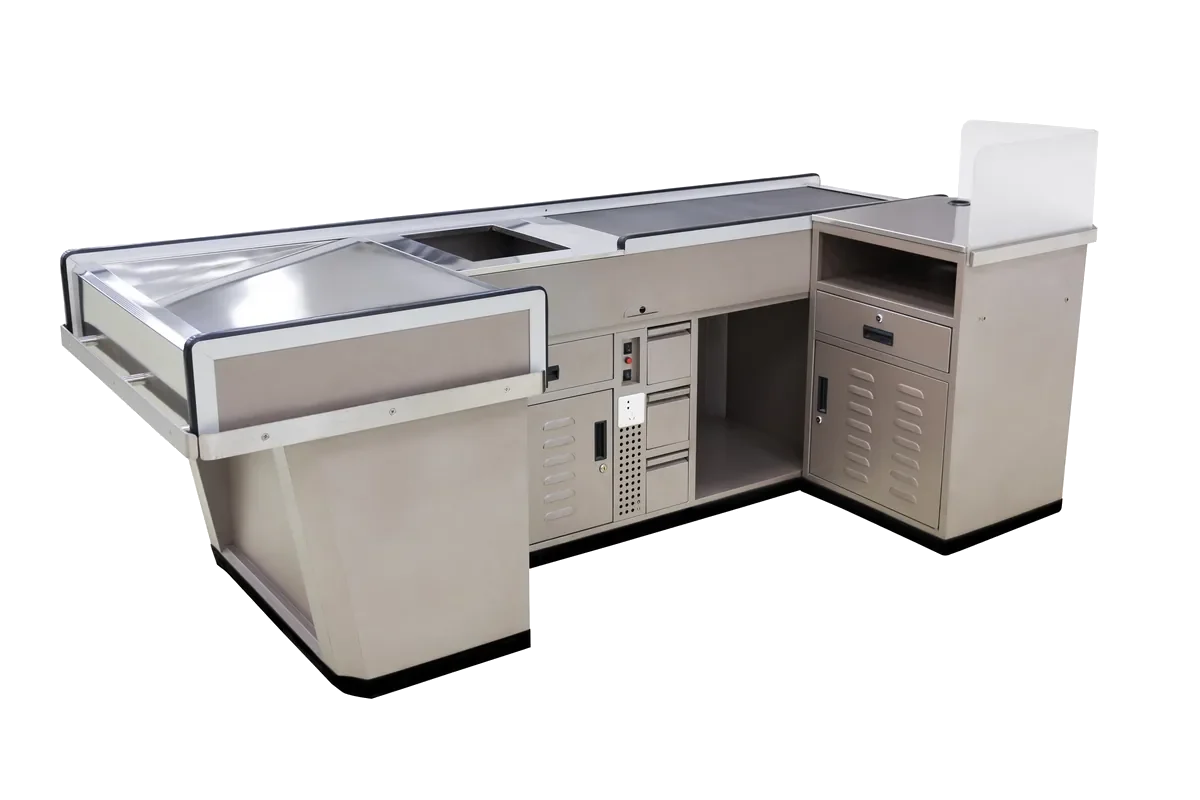
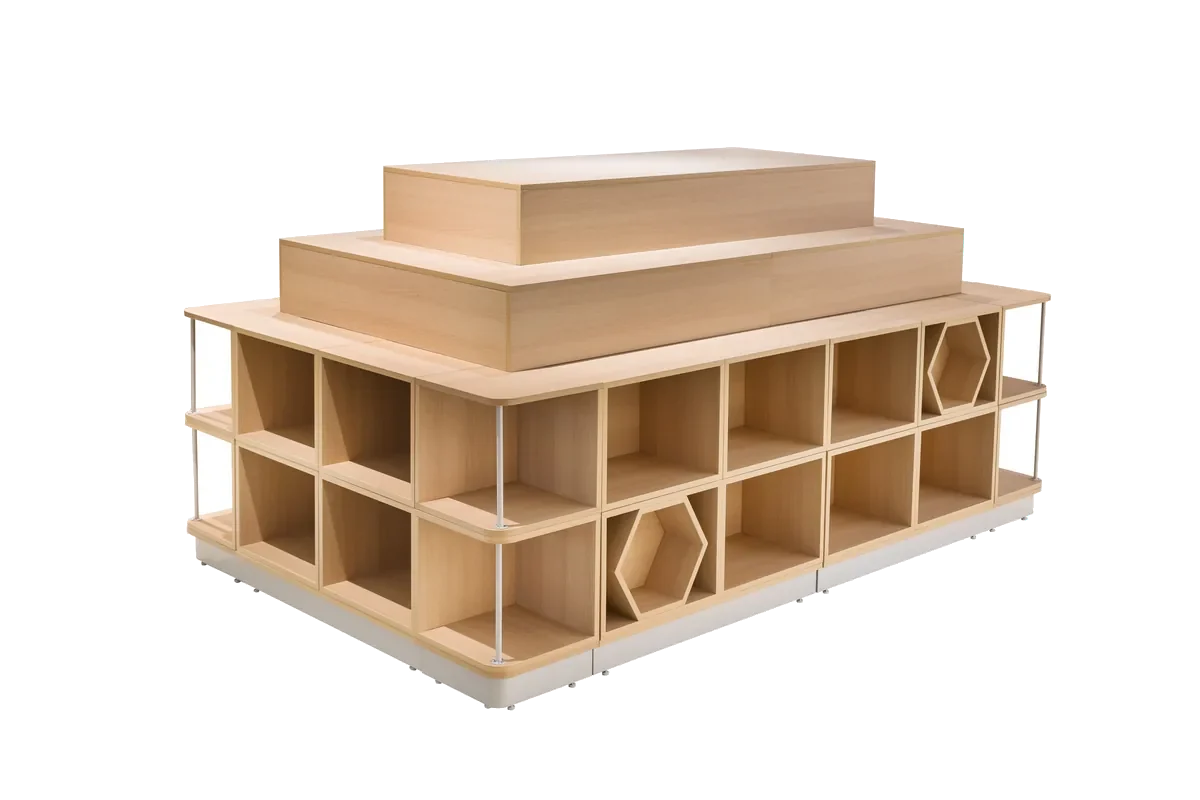
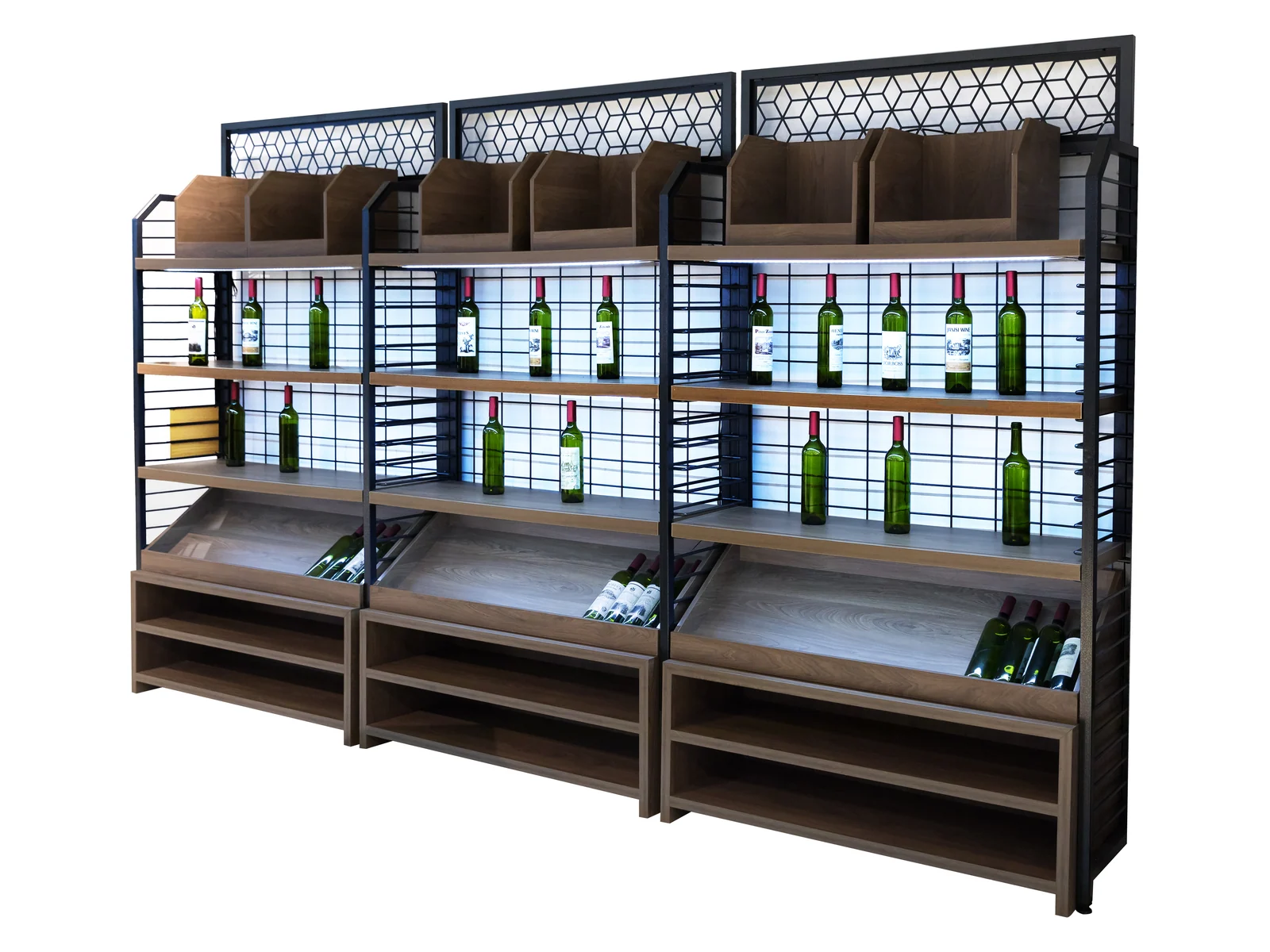
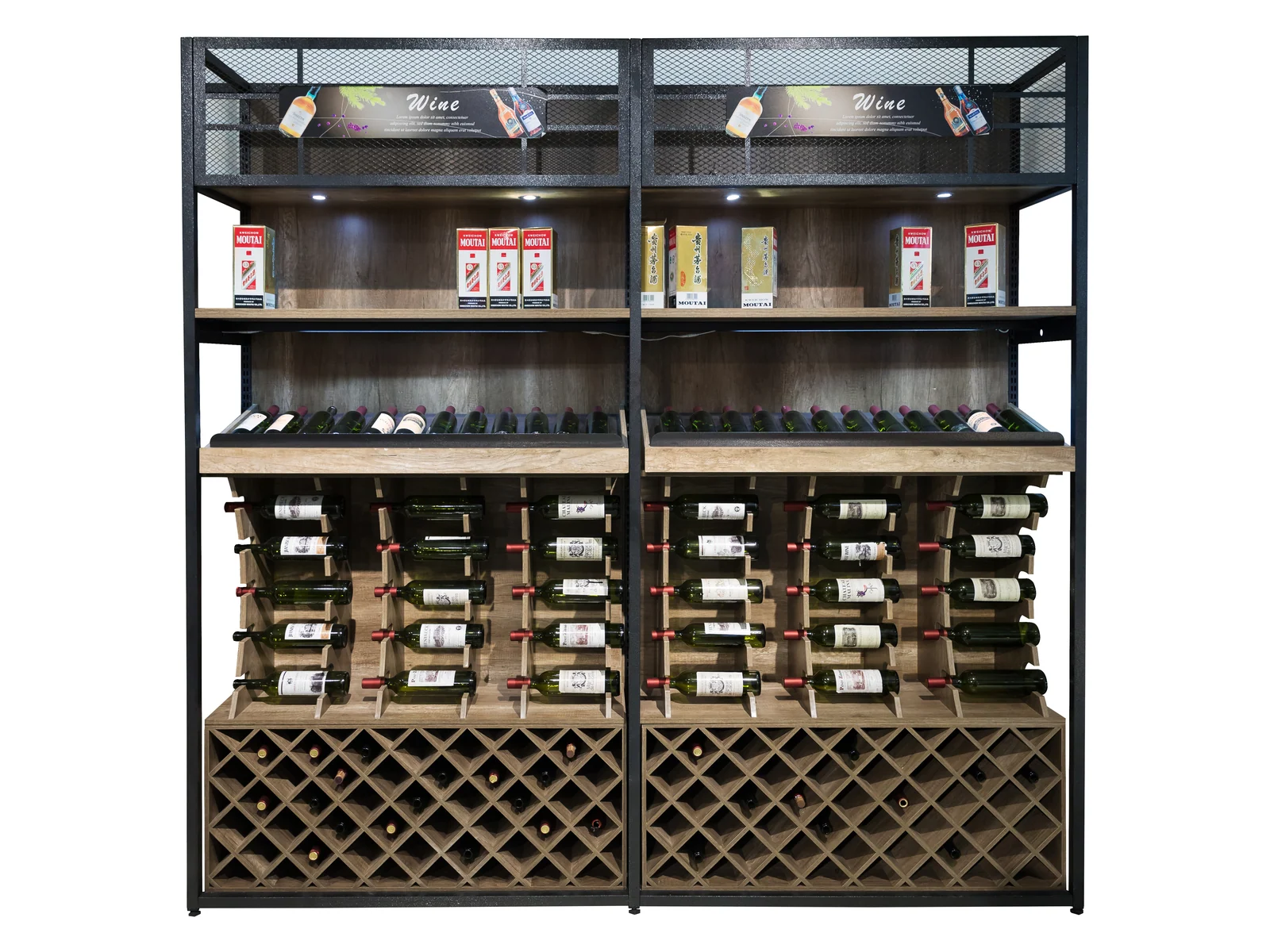
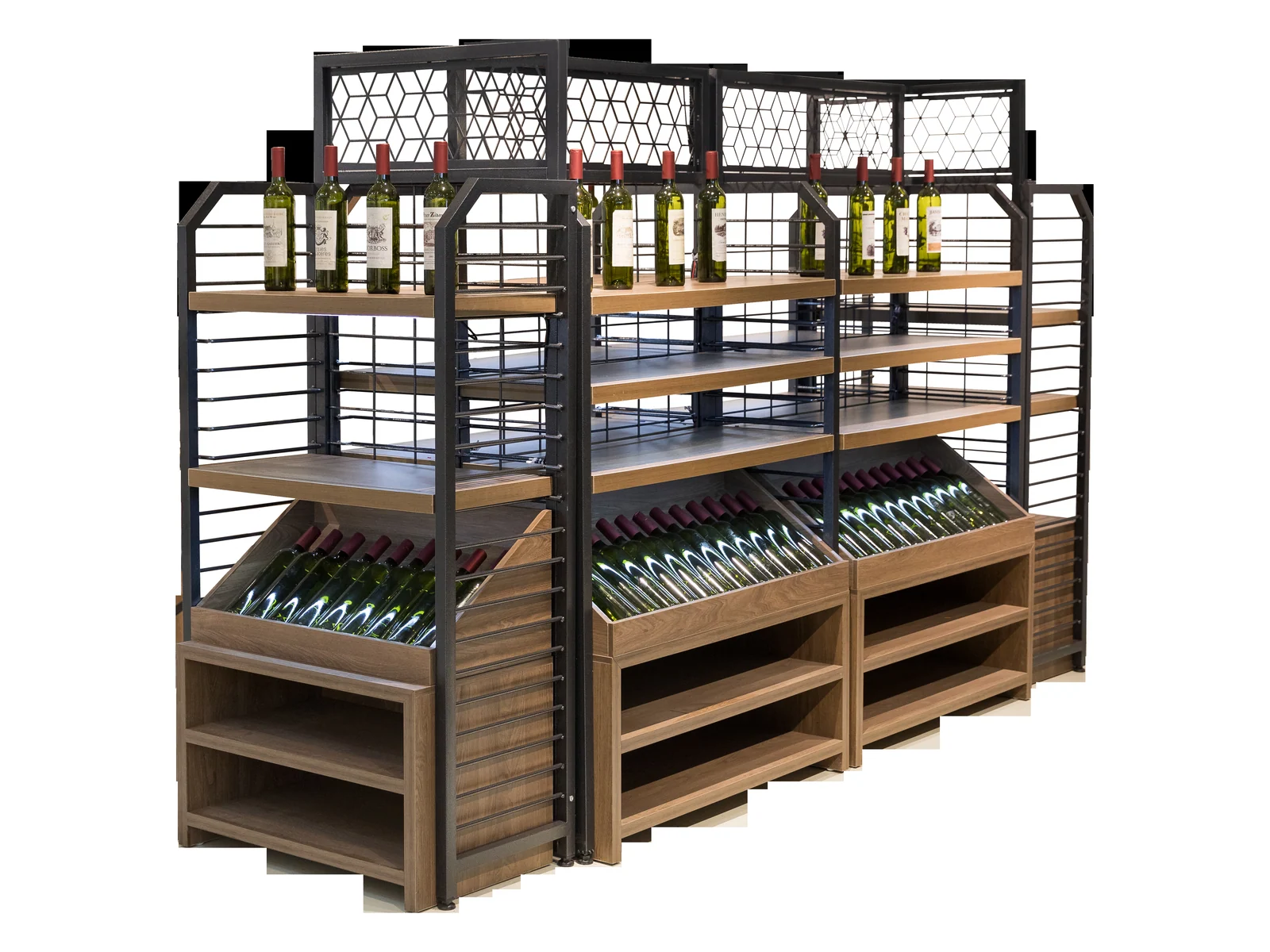
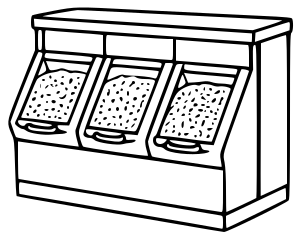
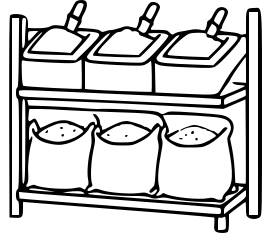
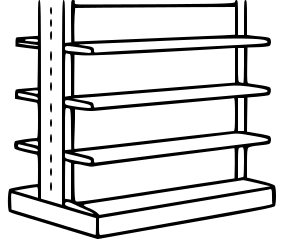
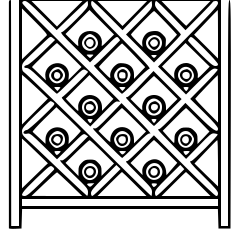
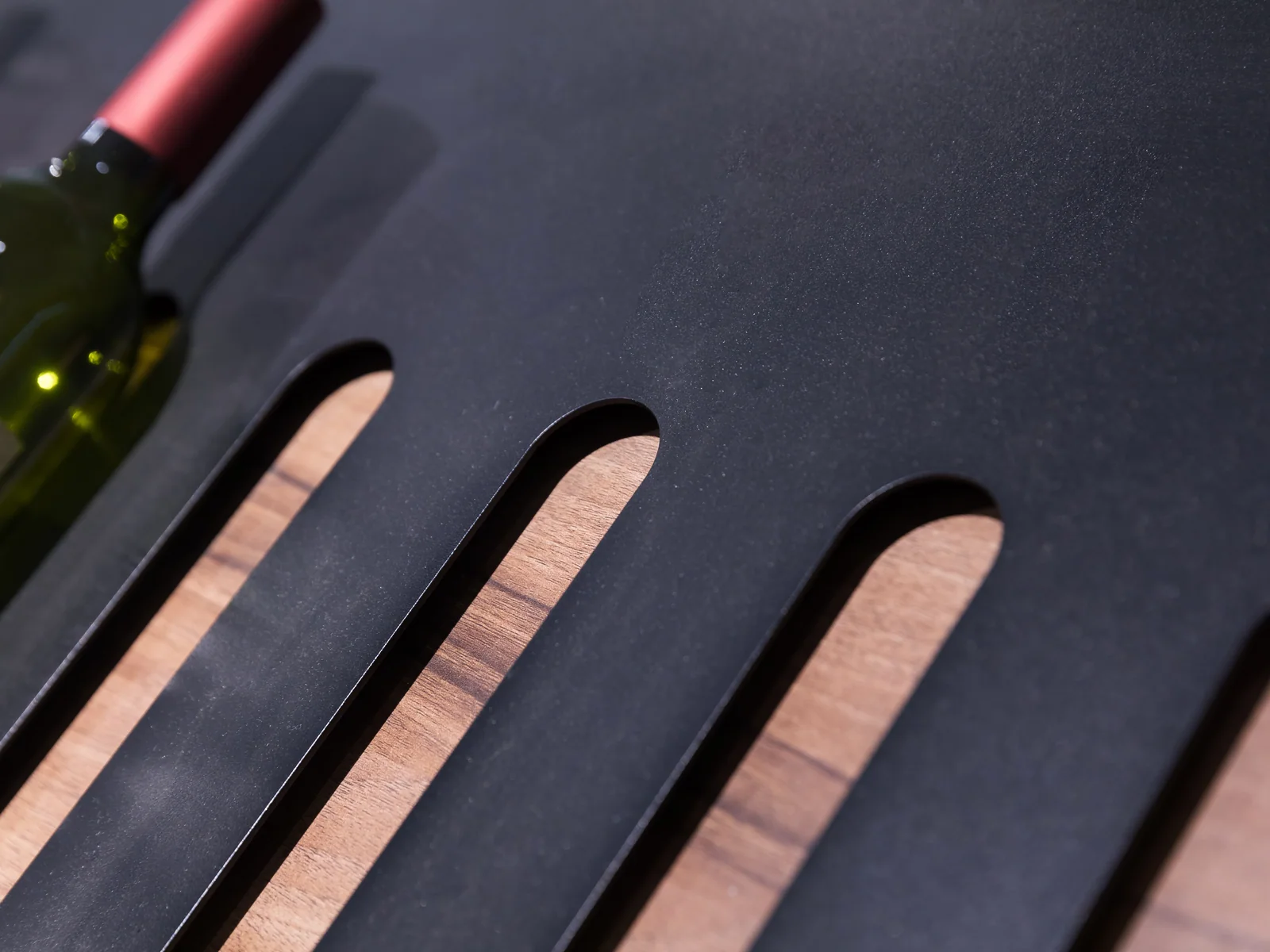
Studio angles on white. The castor, the tier, the crate storage and the frame are photographed below.
Wine is promoted by occasion more than by season: a holiday puts it at the entrance, a food promotion puts it beside the deli, a clearance puts it at the back. A fixed fixture means each of those moves is four people and an hour. This table is on castors, so the same move is one person and two minutes.
It is built as tiered levels in dark timber with black crates below for the back stock, which is the format a wine promotion actually takes — a few facings high, plenty of depth beneath. The steel frame is what carries it: a loaded wine table is heavy, and castors on an under-specified frame is how a fixture ends up out of square by the second move.
A tiered wine table on castors. Wine promotions move — to the entrance for a holiday, to the restaurant end for a food match — and a fixture that rolls is worth more than one that has to be carried.
Supermarkets, convenience stores, chain retail and speciality stores. Tell us the store format and the floor area and the specification comes back written against them.
A fixture on castors is only as good as its castors and its frame. Both are in these four.
Braked or unbraked per order
The castor is what the whole build depends on. Braked or unbraked is set against your floor — on any slope at all an unbraked wine table is a fixture that migrates overnight.
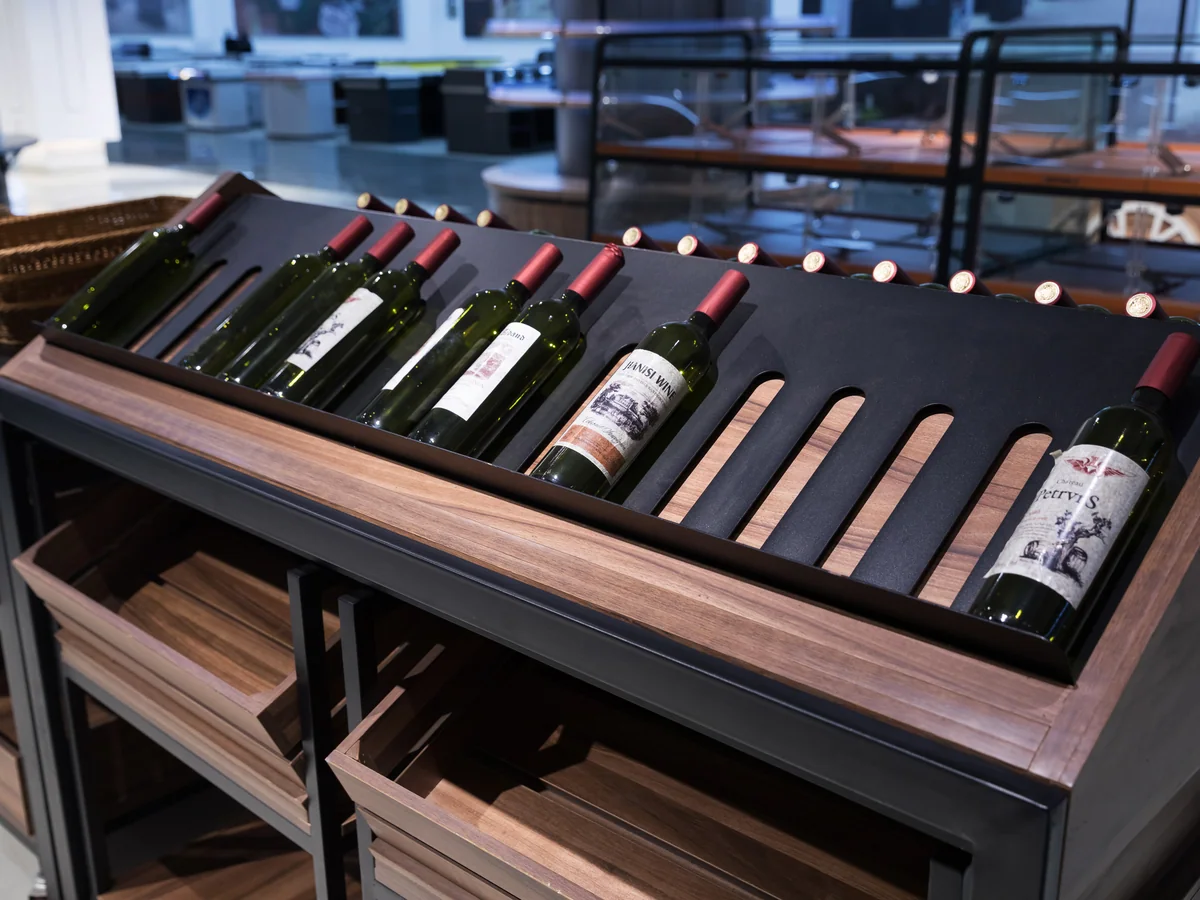
A few facings high
The tiers step back so a shopper reads the whole table from standing. A wine promotion is shallow and wide rather than tall, and the tier spacing reflects that.
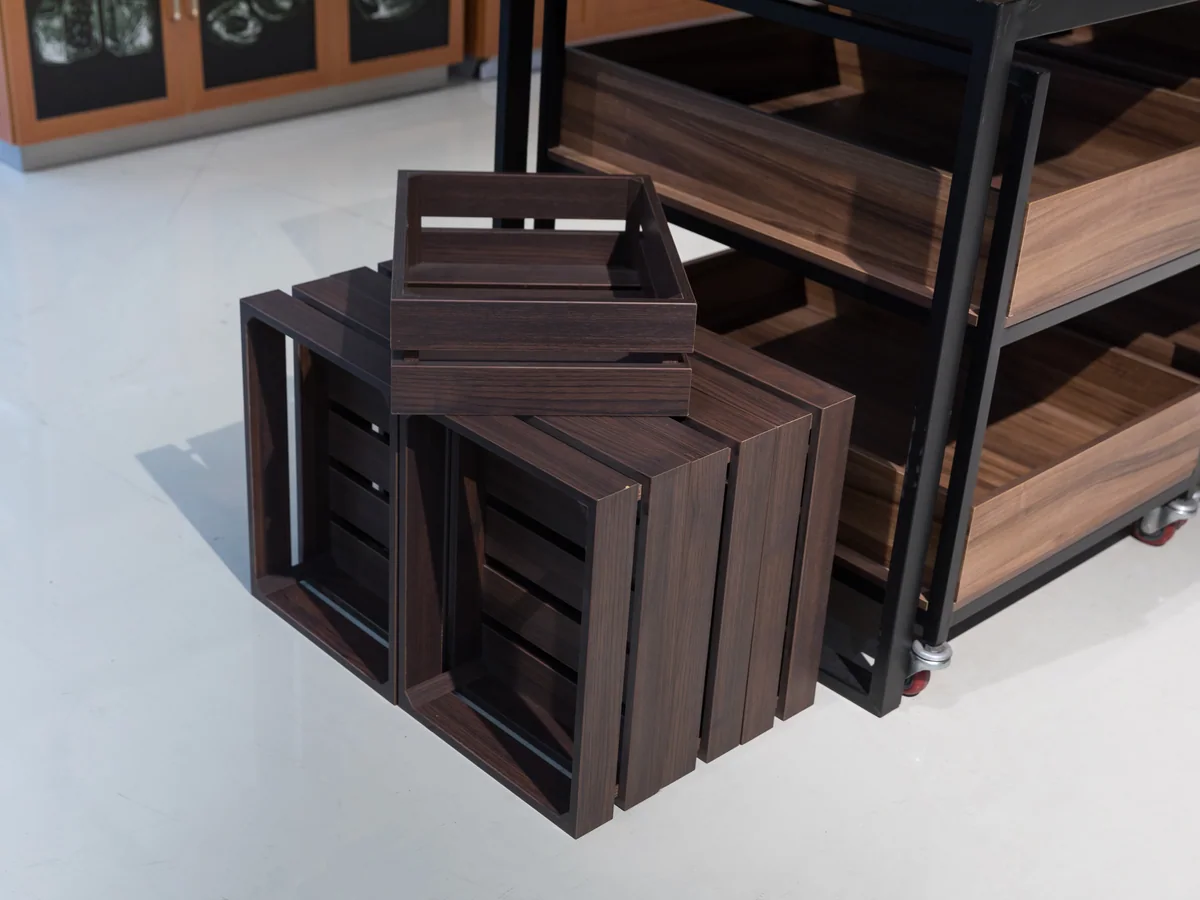
Back stock underneath
Crates below hold the back stock. A promotional table that runs out is worse than no promotion, and the depth underneath is what keeps it stocked through a weekend.
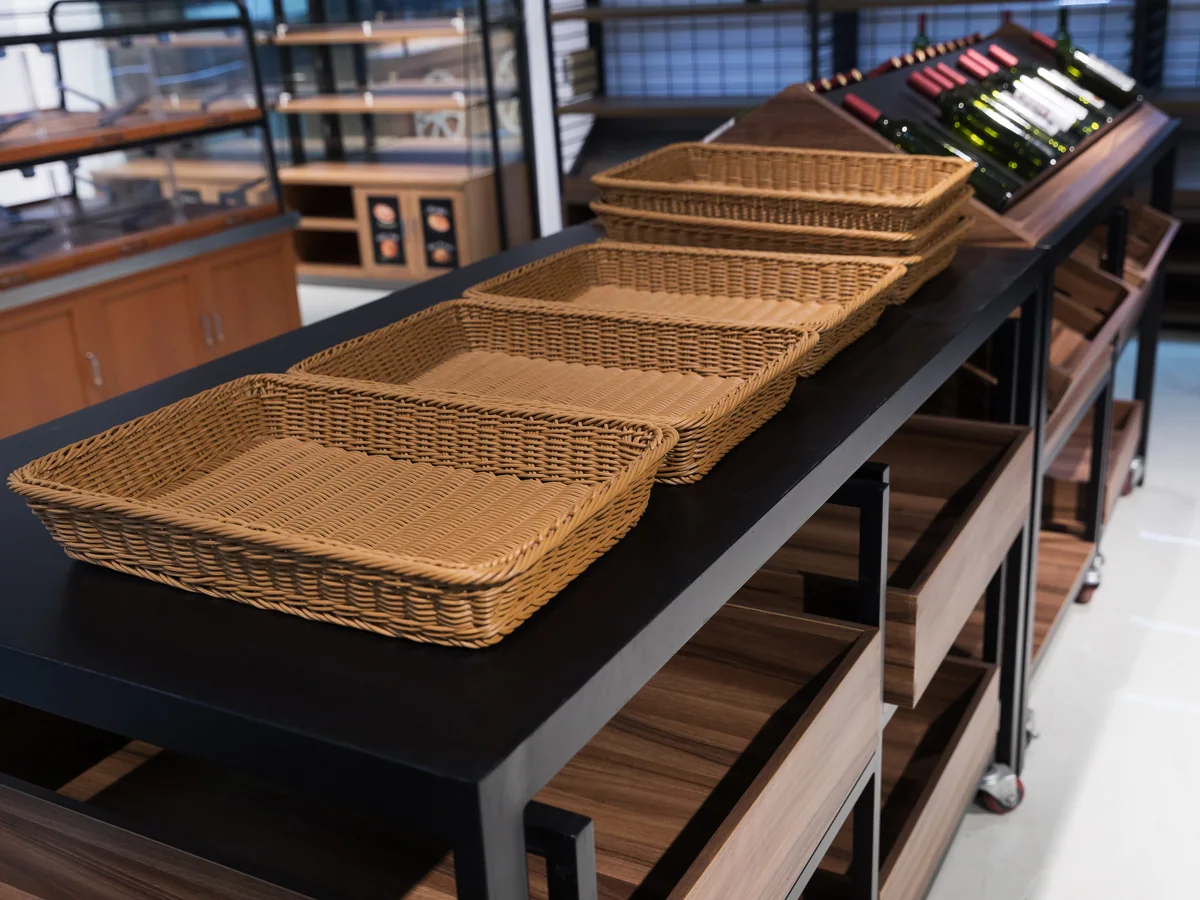
Sized for a loaded table
Wine is heavy and a loaded table on castors puts everything through the frame. It is specified for a fully stocked fixture being pushed, which is a different calculation from one standing still.
Every item on this page is made to order. Send a floor plan, a hand sketch or a photograph of a fixture you like, and we quote against it.
Store fixtures are light for their size, so a container fills up on volume long before it fills up on weight. What decides your freight is not what one unit weighs — it is what shape the goods are in when they go through the container door. Everything we build leaves in one of three shapes.
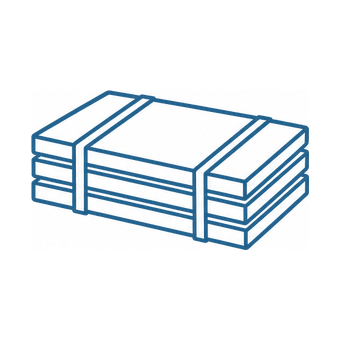
Shelving bays, produce islands and bulk cabinets travel as panels — uprights, shelves, back panels and plinths, strapped flat with bubble wrap on every component. They are built up on the shop floor, so the packing list and the assembly drawings travel with the goods.
This model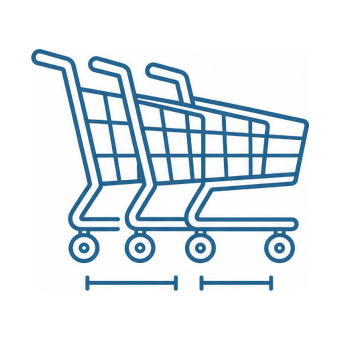
Trolleys slide into one another and baskets stack. Past the first unit, each extra one adds only its nesting pitch instead of its full length, so the shipped volume ends up a fraction of what the unit count suggests.

A checkout lane is welded, coated and fitted out as one piece, so it is crated whole with padding on the steel. Nothing waits to be assembled at the store beyond levelling it into the lane, and the crate is the counter plus a margin.
Wine and tobacco fixtures flat pack as panels, uprights, lattice sections and shelves. Two builds are on record for this category — KS-YJG-01 and wineRack-Y01 — and both are made to the wall rather than sold in fixed sizes, so the case dimensions come back on the packing list once the run is confirmed.
Wine and tobacco are the highest value density in the store, and they sit against fixtures that have to match them.
A wine wall usually terminates a shelving run, so the two carry the same board tone and the same colour reference.
See shelving baysTobacco is almost always behind or beside the lane, which makes the showcase and the counter one piece of joinery to the shopper.
See checkout countersWine is promoted by the case, and a square at the end of the run is where a multi-buy actually moves.
See retail display tablesHow many of each a store needs is a floor area question rather than a product question, and it is answered store by store on the equipment lists by store size.
Tell us where you move promotions to. That sizes the table.
Tell us the positions you actually move promotions to, and whether your floor has any slope. Those two answers set the table size and the castor specification.
The four that come up on nearly every enquiry for this build. If yours is not here, send it with your layout and it is answered alongside the quotation.
On any floor with a slope, yes, and most retail floors have more slope than anyone thinks. Tell us about your floor and we will specify it — an unbraked wine table on a gradient migrates overnight.
The frame is specified for a fully stocked table being pushed rather than one standing still. Tell us how many bottles you intend to put on it and it is checked against that figure.
It can, and then it is a conventional tiered table. Only specify castors if the promotion actually moves — a fixture that never gets repositioned is paying for wheels it does not use.
They can be, but most stores already have crate stock and would rather the table were built to it. Send the crate you use and the storage level is cut to it.