

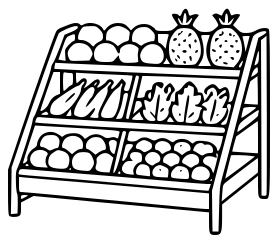
Stepped promotion island with open cubbies
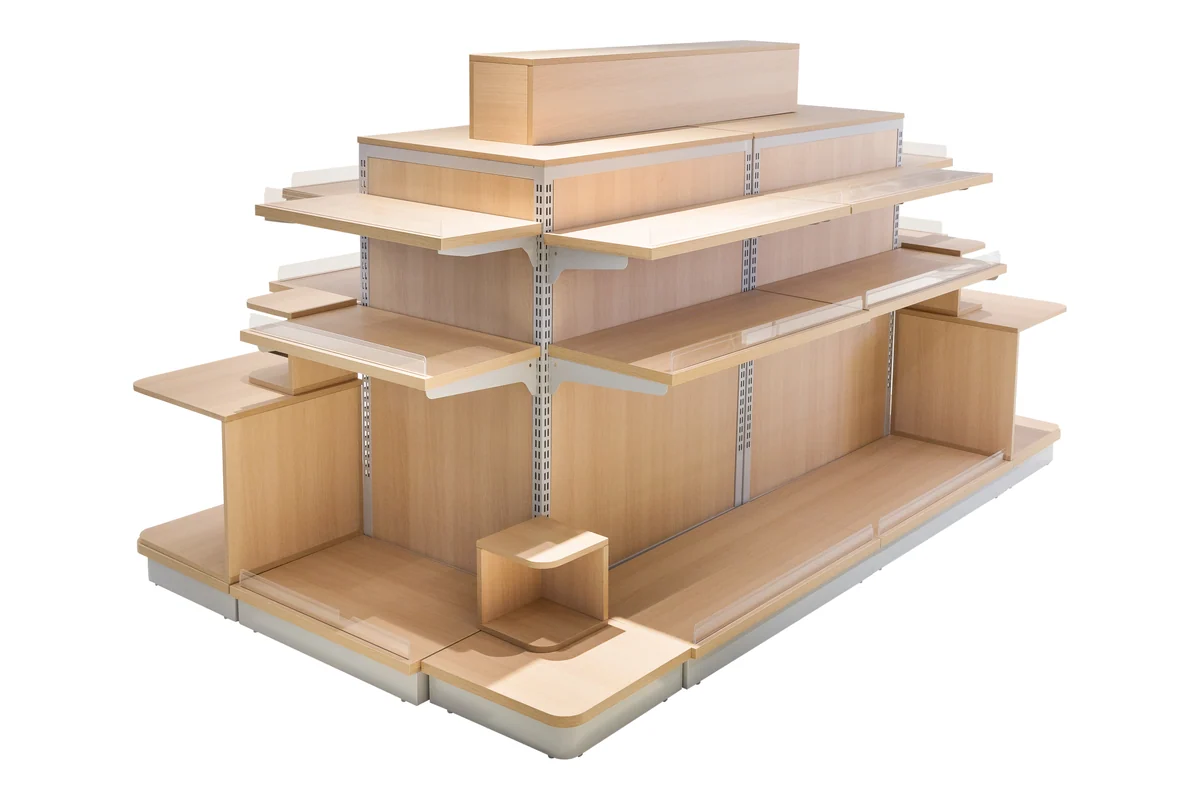
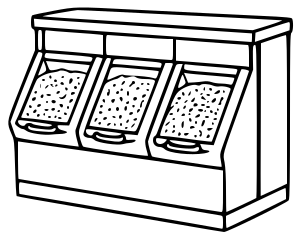
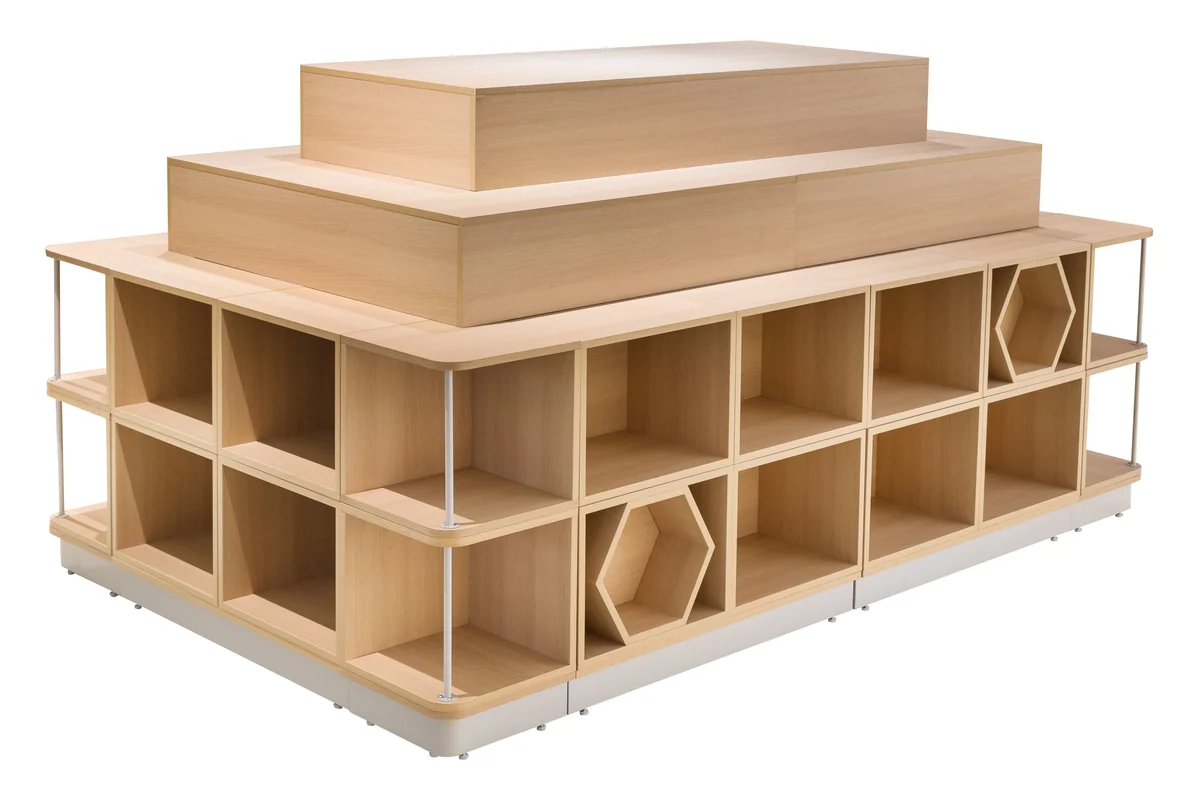
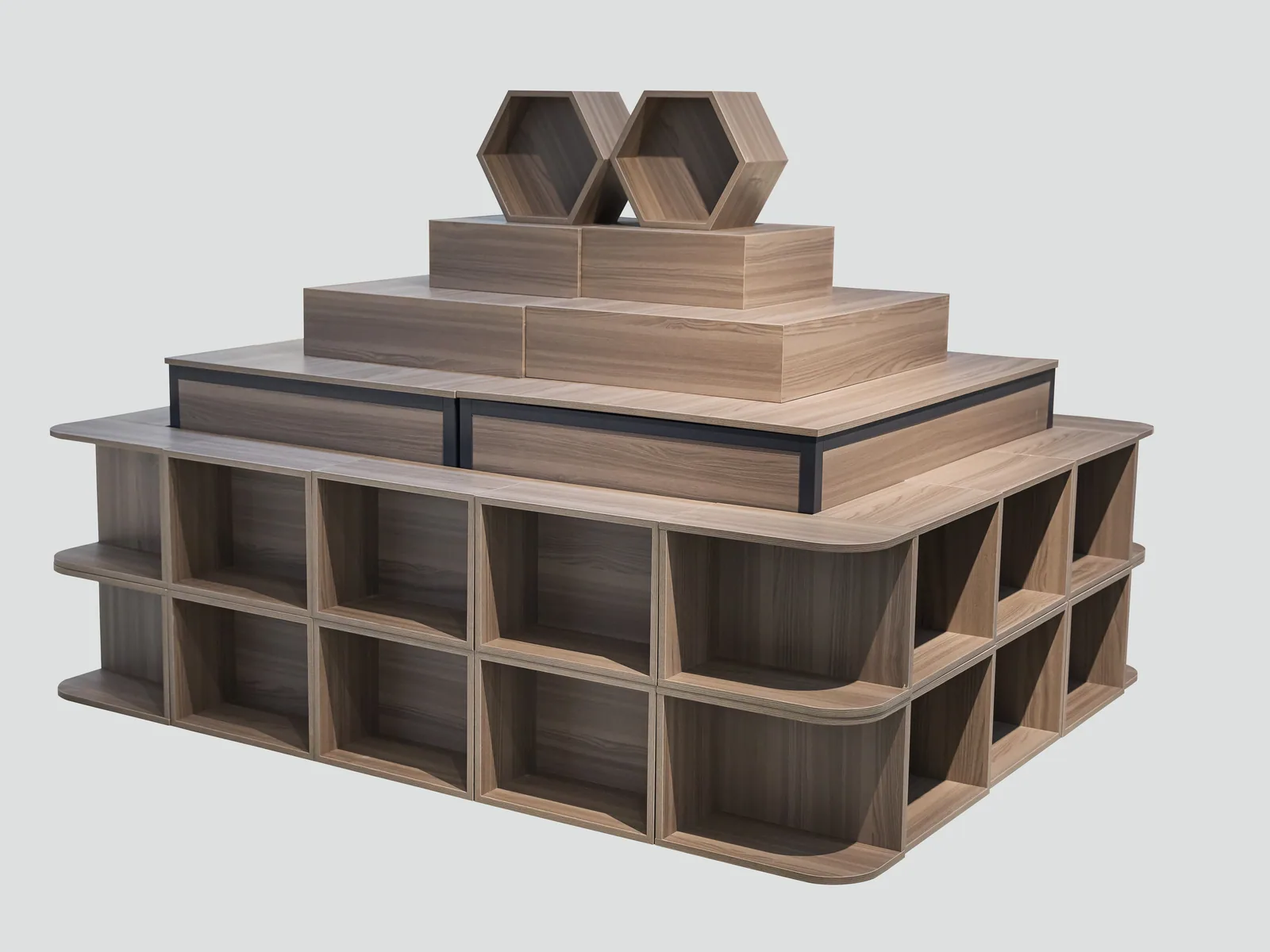
A three-level stepped body with open cubbies right through the base, so bulk stock lives inside the fixture instead of on a pallet parked beside it.
Stepped island with base cubbies
Open the product file
Promotion Tables, Portable Promotional Tables and Combined Display Blocks
A promotion table is the only fixture in the store that is expected to move. Ours are built on a 1000 × 1000 mm square so they can be pushed together into a block and pulled apart again.
Six promotional builds, photographed in our own studio. This is the category a store rearranges most often, so what matters is not how one table looks on its own but how it behaves when four of them are pushed together at the front of the shop on a Friday afternoon.
A three-level stepped body with open cubbies right through the base, so bulk stock lives inside the fixture instead of on a pallet parked beside it.
Stepped island with base cubbies
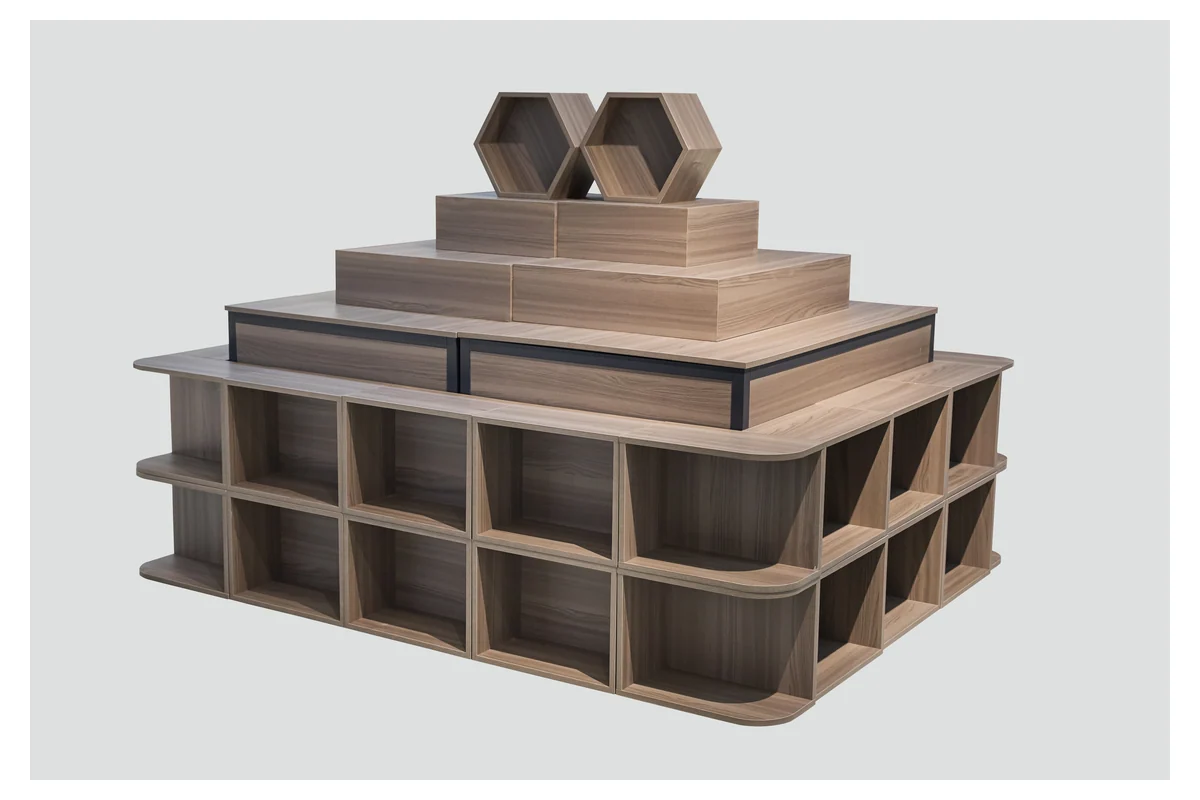
Open the product fileThe same stepped geometry without the cubbies, in a lighter timber. A cleaner body for a store that keeps its back stock in the back and wants the fixture to disappear behind the goods.
Stepped table, closed base
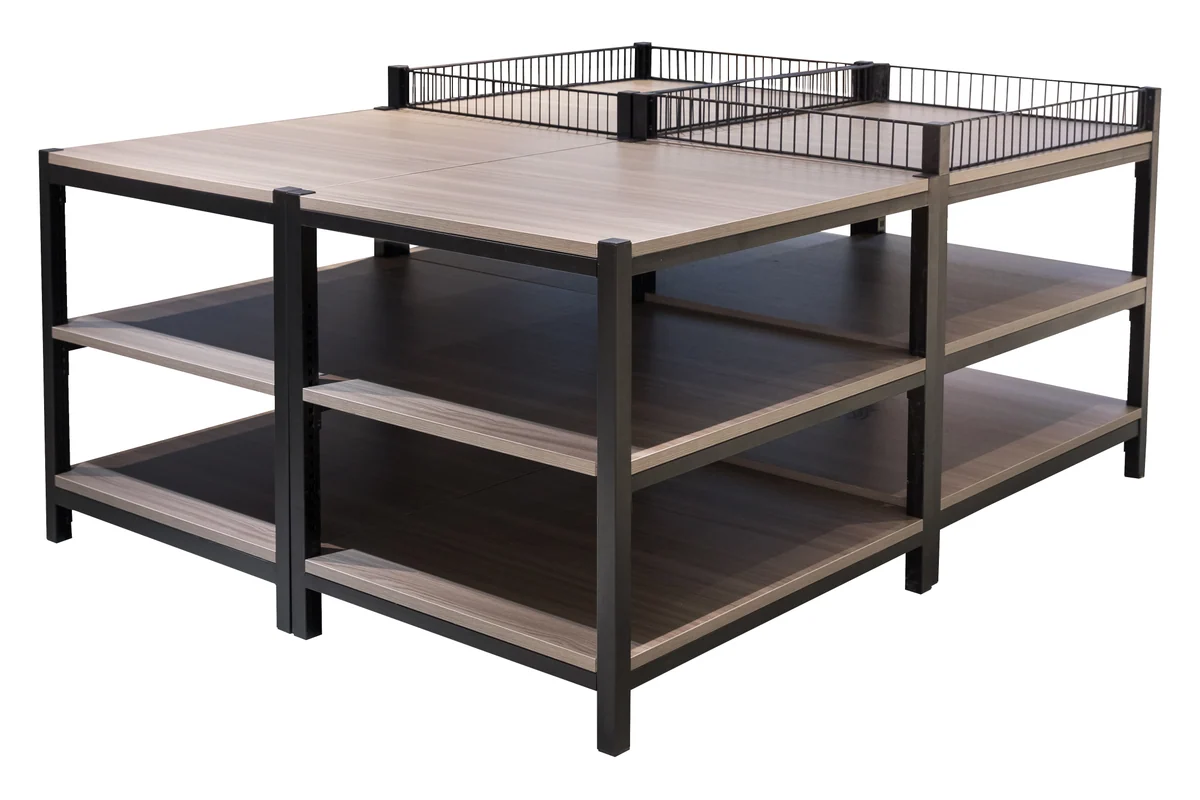
Open the product fileAn all-steel three-tier table with a wire guard rail around the top deck, which is what stops boxed stock walking off the edge when the aisle is busy.
Three-tier steel table, wire rail
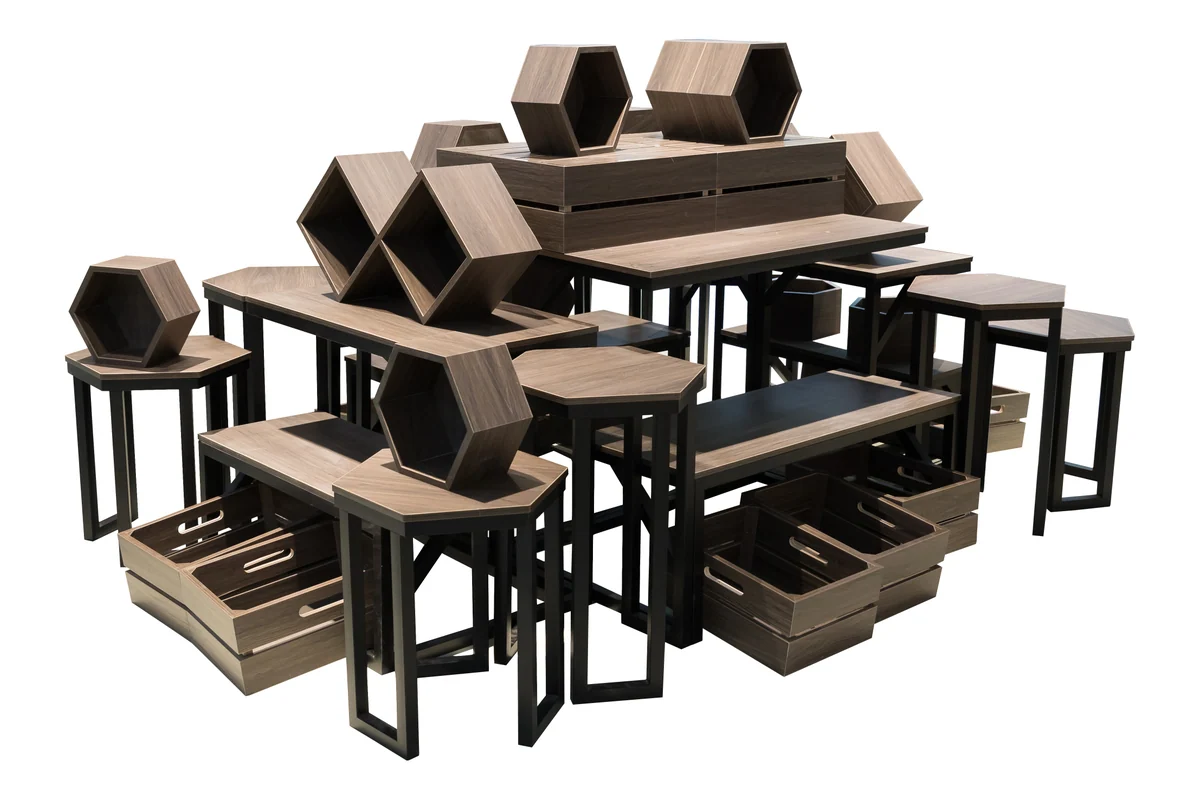
Open the product fileNot one table but an ensemble: nesting tables, open crates and hexagon risers in one timber. Sold as a set because the point of it is the arrangement, which changes every time the promotion does.
Ensemble of tables, crates and risers
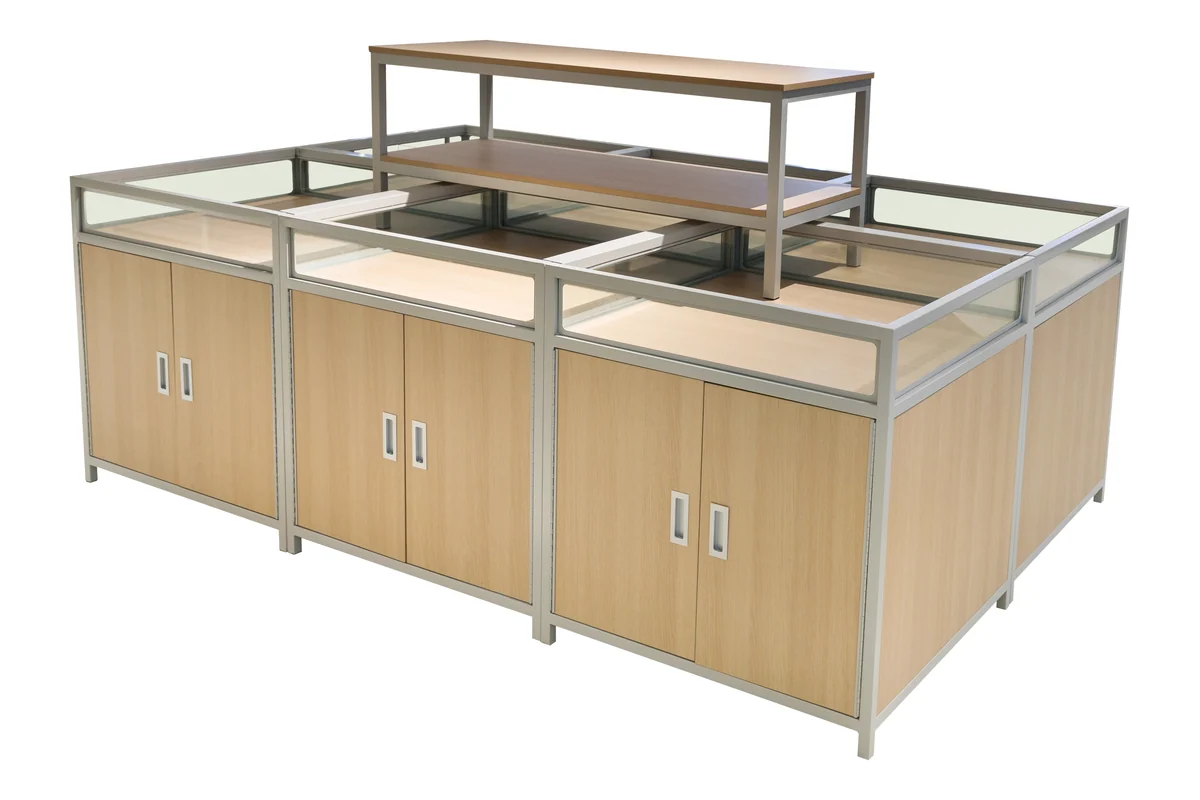
Open the product fileAn aluminium frame carrying a glass top over light timber base cabinets. The one build in the file that locks, which is why it ends up holding the small high-value lines.
Alloy frame, glass top, base cabinets
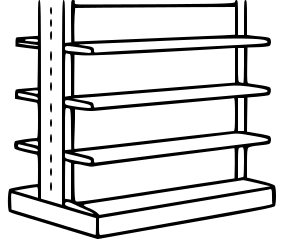
Open the product fileA tiered centre with shelves that wing out on both sides, so a single fixture can carry a headline line on the top and its companion lines either side of it.
Tiered centre with side wings
Open the product fileTwo of these builds carry recorded dimensions and four do not. Sizes for the rest are drawn against your plan rather than guessed at. Colour is a RAL or PANTONE reference held across the whole order, so a promotion block matches the shelving behind it rather than nearly matching it.
Every other fixture in a supermarket is bought to fit a fixed place on the plan. A promotion table is bought to be moved, which changes what the important number is: not how big one table is, but whether two of them line up when you push them together.
Both recorded promotion tables on record are the same size, and it is a deliberate one. A 1000 × 1000 mm square combines in any direction — two make a run, four make a block, and the block is still square. The 800 mm height is 50 mm lower than a checkout worktop because a promotion table is reached into from above, not worked at.
The consequence is worth spelling out: you do not need to decide the shape of your promotion area before you order. Order squares, and decide the shape every week after that.
Two promotion tables on record carry dimensions and both land on exactly the same square. Below them the bars show what those squares become when they are combined, drawn to the same scale so the block sizes are readable rather than arithmetic.
The bottom two bars are not products. They are what the recorded 1000 mm square becomes when it is pushed together, drawn on the same ruler so the block sizes can be read off directly against your floor.
Four of the six builds photographed above have no recorded dimensions, including the glass-topped island and the combined riser set. Those are drawn against your plan; no size has been invented for them here.
The same 1000 mm module, regrouped by how many of them you push together. This is the decision a store manager makes on the shop floor, so it is worth knowing before the order goes in.
A single table at the end of an aisle or beside the door. Small enough that it can be lifted out of the way by two people when a delivery has to come through.
A run along the front of a shelving bay. This is the shape a seasonal promotion usually takes, because it reads as a line of goods rather than as an obstacle.
An island block in the middle of the entrance, shopped from all four sides. The biggest promotion footprint most stores can give up without breaking the walking route.
Nesting tables, crates and risers at different heights in one timber. Nothing is square about the result, which is exactly the point where a store wants a market stall rather than a table.
A promotional display table forks on material, and unusually in this catalogue the fork is about handling rather than about looks. One of these is built to be moved every week by shop staff; the other is a merchandising table built to be arranged once and left looking like furniture.
 Steel
Steel
KS-T-06, 0.8 – 1.5 mm metal sheet
Folded from 0.8 to 1.5 mm sheet and powder coated, with nothing on it that a trolley can chip. Our records list KS-T-06 as metal sheet only. This is the table that survives being dragged across a tiled floor twice a month for ten years.
 Timber faced
KS-T-02, metal sheet and 1.5 – 2.5 mm board
The same square, faced in board over the frame. Our records list KS-T-02 as metal sheet and MDF board together. Warmer against food and fresh produce, and the obvious choice where the promotion area is inside a timber-shelved store.
Both recorded builds are 1000 × 1000 × 800 mm, so a steel table and a timber one stand at the same height and push together without a step. Stores routinely order some of each and mix them by department.
The four things a buyer checks when a sample table is finally standing in front of them, quoted from our own build sheet rather than from a brochure.
 Deck
Deck
Two or three levels
Decks are stepped rather than flat, because a flat table only sells what is on the front edge. Two or three levels put the back of the display above the front of it and roughly double what a shopper can see.
Base
Open cubbies or closed carcase
Open cubbies through the base turn the fixture into its own stock room. It is the difference between refilling a promotion from underneath it and wheeling a pallet through the shop at ten in the morning.
Edge
Wire rail or rolled edge
A wire rail around the top deck keeps boxed stock on the table in a busy aisle. On the timber builds the same job is done by a raised lip pressed into the deck edge.
 Risers
Supplied as a matched set
Risers and crates are made in the same timber and the same finish as the tables they stand on. Bought separately they never quite match, which is why we quote them as one set.
Colour is given as a RAL or PANTONE reference and held across every category on the same order, so a promotion block, the shelving behind it and the checkout beyond it leave the plant in one shade. The finish standard is set out in full on our About page, and the rest of the store is on the product overview.
Tell us how many squares you want rather than how big the promotion area is. Everything here is built on a 1000 × 1000 module, so the shape is yours to change afterwards.
Every question below is one we would have to ask you anyway. Answering them now takes a round trip out of the quotation.
Seven things buyers ask before they order a promotion area. If yours is not here, put it in the message box above and it gets answered with the quotation. Where they go on the floor matters as much as what they are — see Where to Place Promotional Stands in a Supermarket.
Both promotion tables on record are 1000 × 1000 × 800 mm: KS-T-02 and KS-T-06. The square is chosen so tables combine in any direction, and the 800 mm height is 50 mm below a checkout worktop because a promotion table is reached into rather than worked at.
That is what the square module is for. Two make a run along a shelving bay, four make an island block that is still square and can be shopped from all sides. Because they combine, you do not have to settle the shape of your promotion area before ordering — order squares and rearrange them weekly.
The steel builds are, and our records list one of them as a portable promotional table. Steel takes the knocks that come with being moved across a tiled floor twice a month. Timber-faced tables are movable but are usually specified where the arrangement stays put for a season.
A flat table only sells what is on the front edge, because the back of the display is hidden behind it. Two or three steps lift the back above the front and roughly double what a passing shopper can actually see. It is the single biggest difference between a promotion that works and a table with boxes on it.
Yes, and it is worth doing. Risers, crates and nesting tables are made in the same timber and the same colour reference as the tables they stand on. Bought from somewhere else they never quite match, and a promotion block with three slightly different browns in it looks like an accident.
In standard wooden export cases. Because they are square and stack, the loading quantity for this category is better than for most of the catalogue. The exact figure depends on how many are on the order and is confirmed with the packing list.
Both promotion tables on record are exactly 1000 × 1000 × 800 mm, and that is deliberate rather than coincidental. A 1000 mm square tiles into a 2000 mm run or a block of four with no gap and no odd sizes, which is what lets a store buy six and lay them out three different ways.